Why Real-Time Eligibility Verification
Eligibility verification sounds like a front-desk problem. A checkbox. Something a staff member handles before the patient gets called back.
For a single-location practice seeing 40 patients a day, maybe it is. For a multi-location urgent care network or a specialty group with rotating providers and a complex payer mix, eligibility is where revenue leaks — quietly, consistently, and at scale.
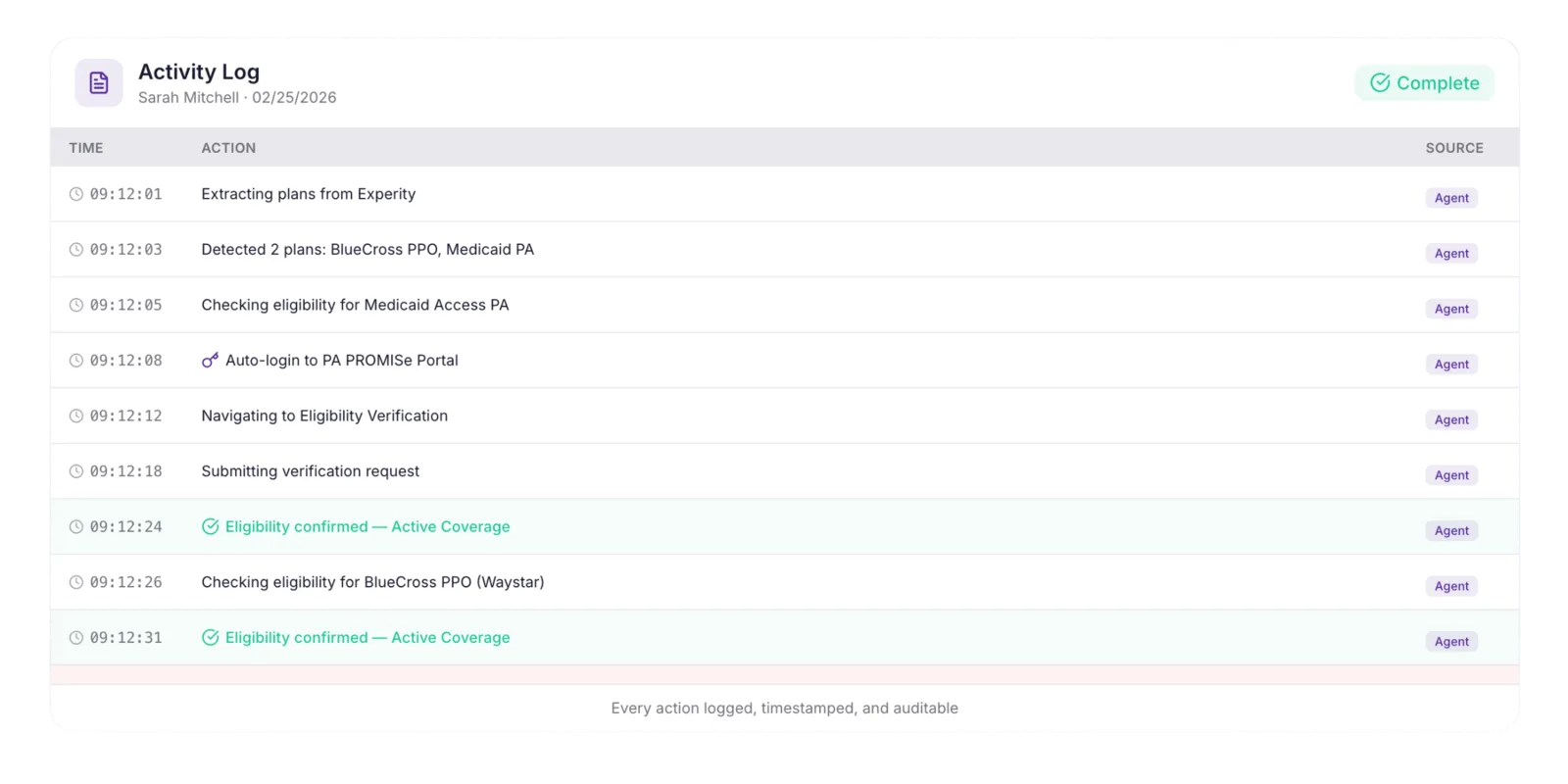
Here's why real-time eligibility verification is a fundamentally different capability than what most practices are using today, and why it matters more the larger and more complex your operation gets.
Every eligibility error at the front desk is a potential denial 30–60 days later. In isolation, one missed verification is a minor inconvenience. Multiplied across dozens of daily encounters, multiple locations, and a payer mix that includes commercial insurance, Workers’ Compensation, Medicare, and specialty plans — it becomes a structural revenue problem.
The most common failure modes at multi-location practices:
Verification skipped under volume pressure. When a waiting room is full, eligibility checks get compressed or bypassed. Staff prioritize patient throughput over verification completeness. The financial consequences arrive weeks later.
Coverage confirmed but benefit details missed. A standard eligibility check confirms a patient is covered. It may not surface deductible status, out-of-pocket maximums, authorization requirements, or network status at the plan level. Claims submitted without this information get denied or underpaid.
Authorization flags not surfaced at intake. For specialty practices and urgent care centers with authorization-heavy payer contracts, missing a required prior authorization at registration is a claim that will be denied regardless of how clean the billing is downstream.
No institutional memory across locations. When eligibility results aren’t stored and accessible, the same verification work is repeated for returning patients — and discrepancies between what was captured at location A versus location B create inconsistencies that compound over time.
The phrase “real-time eligibility” gets used loosely. In the Wurklist platform, it means something specific.
Multi-payer portal checks run simultaneously. Rather than checking one payer at a time — or relying on batch eligibility files that may be hours or days stale — Wurklist’s Real-Time Eligibility Agent checks across multiple payer portals concurrently. The verification happens at the speed the practice needs, not at the speed the payer portal was designed for.
Benefit details are extracted, not just coverage status. Network status is confirmed at the plan level. Deductibles, copays, and out-of-pocket maximums are surfaced in summary format. The staff member at registration sees what they need to make informed decisions — not just a binary “eligible/not eligible” response.
Authorization and referral requirements are flagged instantly. If a patient’s plan requires a referral or prior authorization for the service type being scheduled, that flag surfaces during registration — before the encounter, before the claim, when it can still be addressed.
Results are stored permanently for re-access. Eligibility verification results don’t disappear after the visit. They’re retained in the system, accessible for future encounters, and auditable — which matters both for AR resolution and compliance reviews.
The operational benefit of real-time eligibility verification compounds with scale.
At a single-location practice, a well-trained front desk can manage eligibility with manual workflows and discipline. The surface area is manageable.
At a 14-location urgent care network, or a rheumatology group with multiple providers running concurrent infusion schedules, the surface area is enormous. Manual workflows can’t keep pace. Inconsistency across locations becomes structurally inevitable.
The practices that maintain clean claim rates above 98% at scale are the ones that have removed eligibility accuracy from the variable-human-effort column and put it into a controlled, automated workflow.
This is what Wurklist’s Real-Time Eligibility Agent does. It makes the verification outcome consistent regardless of which staff member is at the front desk, which location the patient is at, or how busy the waiting room is.
A 99% clean claim rate — the standard EMPClaims delivers — doesn’t happen because claims are fixed quickly. It happens because eligibility errors are caught before they become claim errors.
The path from eligibility verification to clean claim submission looks like this:
When eligibility verification is incomplete or inconsistent, every subsequent step in that chain becomes reactive. You’re correcting at the claim level what should have been caught at the intake level.
For a multi-location practice running hundreds of encounters per week, the difference between proactive and reactive eligibility management is measured in denial rate, AR days, and staff hours spent on rework.
Urgent care is where eligibility failure is most expensive – because the volume is high, the pace is fast, and the payer mix is unpredictable.
Consider a walk-in patient presenting on a Saturday afternoon. The front desk is running at capacity. Registration happens quickly. Insurance is entered as provided. A basic eligibility check confirms coverage.
What it may not surface:
Each of these gaps produces a different downstream failure – a denied claim, an underpayment, a Workers’ Comp claim buried in the commercial AR queue, or a claim that can’t be submitted at all. In a practice running 100+ encounters per day across multiple locations, these aren’t edge cases. They’re daily occurrences.
When EMPClaims partnered with a 14-location AFC urgent care network, charge entry lag was running at 14 days and Workers’ Comp AR had aged to over 100 days. Eligibility and intake accuracy were foundational to the fix – not just the billing workflow downstream. The result was a charge entry cycle reduced to 3 days and a net revenue increase of 8.5% within the first year.
Wurklist’s Real-Time Eligibility Agent addresses exactly these conditions: high-volume intake, payer mix complexity, and the speed constraint that makes manual verification impractical at scale.
Eligibility verification doesn’t exist in isolation. In Wurklist, it’s the first step in a unified revenue cycle workflow:
Eligibility → Prior Authorization routing → Coding → Clean Claim Submission → Payment Posting → AR Management → Reporting
When eligibility data is accurate and stored, it informs every downstream step. Authorization requirements identified at registration feed directly into prior auth workflows. Verified benefit details inform patient billing. Demographic data flows cleanly into claim creation.
The platform operates as what EMPClaims calls a Revenue Command Center — not a collection of disconnected tools, but a single operational view of the revenue cycle from first patient contact to final payment.
Table of Contents
Add a header to begin generating the table of contents
If your practice is seeing eligibility or registration denials above 3–4% of total claims, the workflow has a structural gap. If your AR is regularly catching authorization-related denials that should have been flagged at intake, the verification process isn’t surfacing what it needs to.
Real-time eligibility verification isn’t a feature upgrade. For multi-location practices, it’s a foundational revenue control.
See how Wurklist works
Talk to an RCM specialist
Bring us your denial data and we’ll show you exactly where the revenue is leaking — and what it would take to close it.
